Requests and ownership · Form publishing and task-template contracts
Publishing the form people actually see
Source-reviewed technical draft. Diagrams and walkthroughs use abstract or invented inputs. Implementation, reported use and measured outcomes remain separate.
A request form is part of the routing system. If its conditional questions drift, the task arrives with the wrong information before anyone has a chance to review it. A field editor alone does not solve that problem. The published form needs to match the rules the agency expects requesters to follow.
My Atlas contribution history includes the Form Matrix editor, version-control work, Teamwork synchronization, question binding, publish gates and later task-template contracts. The story is the boundary between an editable configuration and a live external form: what gets reviewed, what can become stale, and what must stop a publish.
From an editor to a publishing contract
The July editor work established an editable, versioned field matrix. Subsequent changes addressed the harder integration problems: finding the live request-type question, preserving conditional branches, binding fields to real Teamwork question identities, and retaining fields outside Atlas's ownership.
My publish-gate work ties the candidate to the current Atlas configuration and external form. The route compiles publishable fields, evaluates request-path visibility and checks ownership and canonical rules. Publishing requires a reason, the reviewed configuration hash, external-form fingerprints and matching snapshot evidence. The route checks those values again before mutation.
That gives the operator something specific to approve. They are approving a candidate based on a particular configuration and a particular external form, rather than whichever state happens to exist when they press Publish.
The implementation also checks the runtime environment. In this source snapshot, publishing is allowed only with recognized dev/local signals and is blocked by production or staging signals. That boundary describes Atlas's permitted execution context; it does not make an external form harmless simply because the caller runs in dev.
Inspect the system diagram
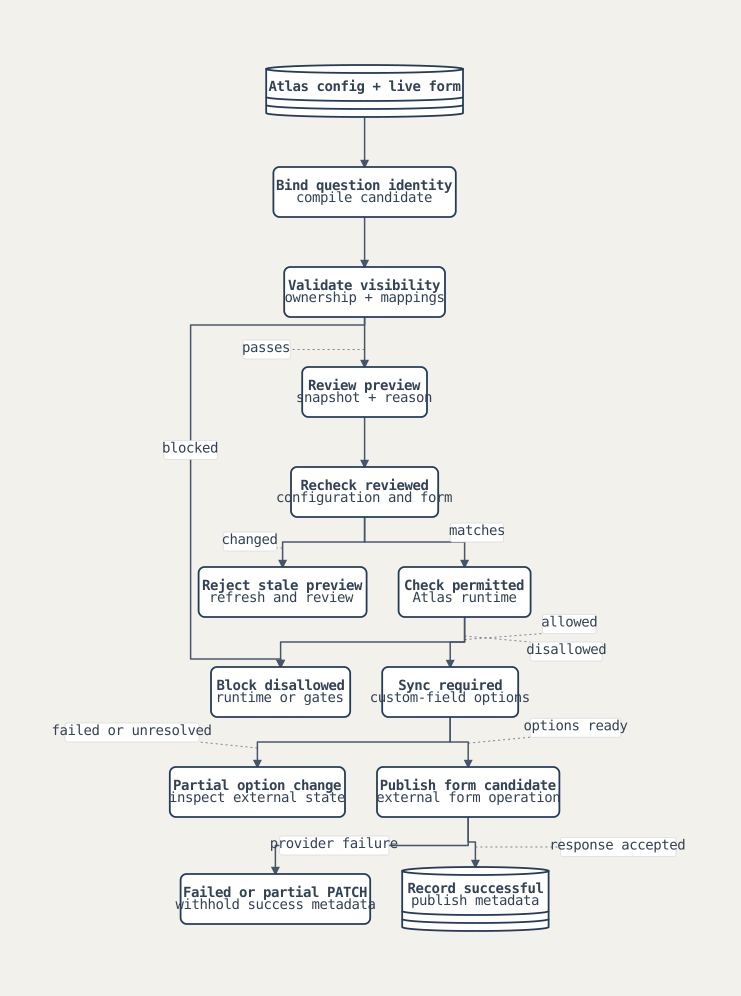
Full-size vertical SVG · Horizontal SVG. Static source model generated with Carl Illustration Engine; partial external changes require inspection.
Two decisions that changed the workflow
**Bind to identity, then check the round trip.** Labels can change, aliases can be legitimate, and generated placeholders are not reliable external identities. The binding and gate work distinguish these cases instead of treating a matching label as sufficient proof. Duplicate IDs, placeholder identities, unexpected round-trip changes and edits outside ownership can block publishing.
The accepted cost is a stricter integration contract.
A form that looks right in the editor can still require repair before it is publishable. The alternative of relying on labels and visual inspection would make it easier to overwrite the wrong external question. This comparison explains the implementation tradeoff; it does not invent a historical design meeting.
**Make the review expire when either side changes.** My version-control contributions connect the submitted configuration hash, form fingerprint, definition hash and snapshot. They must still match. If Atlas or Teamwork changed after preview, the route returns a conflict and asks for a fresh preview before changing the form. This costs another review step. It keeps an old approval from silently authorizing new content.
The implementation couples that freshness check with semantic gates. It evaluates visible fields for every canonical request path, requiredness, options, custom-field mappings, route instructions and ownership. A structurally valid payload can still be the wrong form.
The failure that sharpened the gates
The authored change records a concrete failure: the live Teamwork form had drifted from the canonical design, and non-canonical fields leaked into the general fallback request path. The fix introduced explicit blockers for those differences, hidden-required conflicts, invalid question identities, stale preview evidence and missing version-control evidence.
The authored change addressed duplicate or misplaced fields caused by global context, deprecated helpers and conditional branch children. Its description reports a historical 23-scenario live QA result and names supporting artifacts.
Those artifacts have not been independently inspected in this case-study pass. I keep that report separate from newly verified production results.
Partial external changes still matter
The publish sequence is not a distributed transaction. Custom-field options can be synchronized before the form PATCH. If some option updates succeed and another fails, the route reports the succeeded and failed field IDs and stops before publishing the form. A form PATCH can also fail or report a partial result. In that case, successful publish metadata is not written.
Keeping metadata honest does not undo external changes.
An operator may need to inspect Teamwork, repair the partial state and generate another preview. This limit belongs next to the architecture diagram, because “publish blocked” and “nothing anywhere changed” are different claims.
Versioned snapshots support review and recovery, but this draft does not claim that every external update is atomically reversible. Later task-template work also needs its own boundary: draft catalog, editor snapshots and adapter contracts are not proof that live task templates were activated.
Synthetic walkthrough
I use an invented sequence to explain the contract. It contains no real client form or run log.
- A reviewer previews configuration
config-Aagainst external definitionform-Aand snapshotsnapshot-A. - Another edit changes the external definition to
form-B. - The reviewer submits the original publish evidence. Freshness checks return a conflict before the form mutation.
- The reviewer refreshes the preview. A request-specific field is visible on the general fallback path, so the semantic gate blocks the candidate.
- After correcting visibility, a custom-field option update partially fails. The response identifies the partial option work and withholds form publish success.
- The operator inspects and repairs external state, then performs a fresh preview and publish attempt. Success is recorded only after the form operation passes its response checks.
What the evidence supports
I can trace my merged contributions to an inspectable publishing contract. The record supports explaining how identity, conditional logic, ownership, configuration freshness and partial external failures interact. It does not establish current operator volume, a reduction in malformed requests, time saved, current deployed revision or sole ownership of every dependency.
For an engineering interview, this is a useful example of making an external mutation reviewable. The hard part was keeping preview, permission, source state and provider response aligned. An AI-generated form configuration would need the same boundaries before publication.
Discussion notes
Three-minute outline. explain the request-path problem; trace preview identity and freshness; show a blocked stale candidate; finish with partial custom-field synchronization and the absence of a distributed transaction. Use the synthetic sequence above, not a live publishing endpoint.
Questions to prepare. Why are labels insufficient for identity? What does a snapshot prove? Where is the race between final read and external mutation? How would recovery handle a partial option update? Which checks require runtime evidence beyond unit tests?
Application summary. My Form Matrix contributions made external form updates inspectable: versioned configuration, stable question binding, conditional-path checks and stale-preview rejection. I also kept partial provider failures from being recorded as a successful publish.
This contribution narrative is supported by privately held source and authorship records. It contains original explanations and abstract diagrams, without employer code, customer records or runtime telemetry. Missing outcome evidence stays explicit.