Integrations and shared platform · Teamwork API contracts and integration health
Deciding when an integration is ready to do work
Source-reviewed technical draft. Diagrams and walkthroughs use abstract or invented inputs. Implementation, reported use and measured outcomes remain separate.
I contributed to Teamwork's integration contracts and health checks so that an operator could distinguish an endpoint listed in a registry from an endpoint that had returned useful, current evidence. That distinction matters when forms, task routing and board automation depend on the same external service.
A successful HTTP response is only one part of readiness.
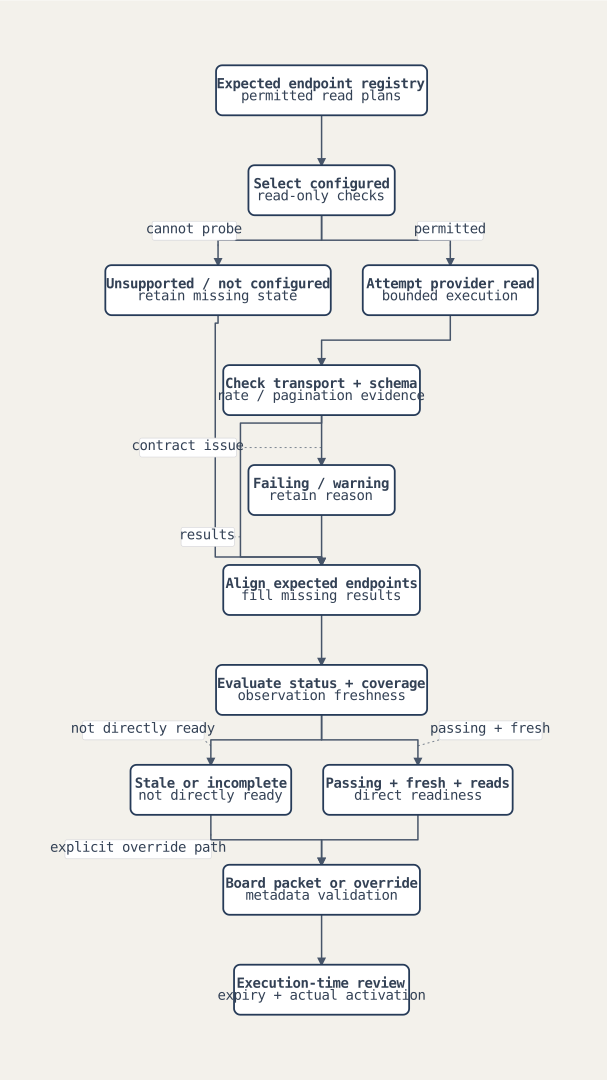
The inspected classifier checks expected task, form and custom-field response shapes. Authentication and permission failures receive specific classifications. Rate limits become warnings, and missing or malformed rate-limit headers can also produce a warning. Task-list responses with unrecognized pagination do not silently establish a healthy contract.
Give missing evidence a state
The health work develops from a static endpoint inventory through bounded development reads and production-readiness contracts. I retain that progression because a registry, an offline fixture, a manual development probe and an active production monitor answer different questions.
The inspected development runner selects permitted read-only registry entries. Configuration that cannot support a probe yields not_configured; unsupported plans retain an unsupported state. Executed reads are classified, and execution errors produce bounded failure reasons. This source inspection performed no live probe.
I also made the evidence smaller than the response.
The selected evidence shape records method, version, response class, latency, field presence, counts, a structural hash, rate-limit metadata and bounded reason codes. A recursive check rejects specified unsafe keys and oversized strings. This is a deliberate evidence contract; it is not a guarantee that arbitrary future payload fields are automatically redacted.
Inspect the system diagram
Coverage and freshness belong in the decision
The authored change adds a production-monitor summary. It aligns returned results with the expected endpoint list, synthesizes a missing-result state for uncovered entries and evaluates the observation's freshness. Production readiness requires passing status, fresh evidence and attempted live reads.
I would show the missing-result branch before the passing branch.
That is where a partial check can otherwise become a false green light. Stale evidence can raise a launch-critical alert even if the recorded probes originally passed. The ledger contract also checks timestamp validity and bounds retention to the configured policy; source existence does not prove that a scheduled monitor or database TTL policy was activated.
The same PR connects API health to board readiness packets. A packet can carry direct readiness or an explicit override containing approval metadata, a reason and an expiry timestamp. The inspected packet verifier validates the supplied freshness classification and timestamp shape. It does not itself recalculate observation age against the current clock or reject an override simply because its valid timestamp is already in the past.
That boundary needs an honest explanation.
I would require the caller and the eventual execution boundary to enforce those time-sensitive conditions before claiming a complete expiry gate. I do not present this packet validator as an independent authorization service or evidence that a production canary ran.
Invented operator walkthrough
- Start with a synthetic registry containing task-detail and form-detail checks.
- Return a valid task result and omit the form result. Show coverage preventing readiness.
- Supply both valid results, then move the clock beyond the freshness window. Show stale status.
- Return HTTP success with the wrong task shape. Show contract failure despite transport success.
- Inspect the bounded ledger fields without displaying the provider response body.
- Review an override packet and identify where current-time expiry must still be enforced.
This is a reconstruction of classification and packet-validation behavior, not a live Teamwork health check or launch.
Contribution and result
The authored records establish control-plane and integration-health work across the authored change, the authored change, the authored change and authored changes. Historical test summaries in PR descriptions are not tests rerun for this collection. I do not claim improved uptime, prevented incidents or activated board automation without run evidence.
My contribution story is the contract between an external integration and the systems relying on it. The related Form Matrix, DRI Matrix and Intake Router chapters show how these boundaries connect to operational work.
Discussion notes
Three-minute outline. registry versus observation; schema and coverage failures; stale passing evidence; bounded ledger; the execution-boundary conditions still needed.
Questions to prepare. What counts as a complete check? Who computes freshness? Where is override expiry enforced? What evidence belongs in a health ledger? How should read-only readiness differ from approval to mutate a board?
Application summary. I contributed external-service contracts and readiness checks that distinguish configured endpoints, attempted reads, valid responses, missing coverage and stale evidence. I can explain how those checks support downstream workflow decisions, and where packet validation still needs execution-time enforcement. That is directly relevant to deploying customer integrations with visible failure states.
This contribution narrative is supported by privately held source and authorship records. It contains original explanations and abstract diagrams, without employer code, customer records or runtime telemetry. Missing outcome evidence stays explicit.